
Whilst your website still works it may be in need of an aesthetic and functional update. Small tweaks can sometimes be like pulling at a knitted item – easily causing it to come apart. Should you choose to update or redevelop your website? As with most things, it really depends. An update will solve aesthetic issues and redevelopment will resolve functionality ones. Both can prove expensive if approached incorrectly. Good quality web designers will always investigate the issues affecting your current site before providing a quotation. As a business owner you should also analyse your site in this way.
Understanding when to update and when to redevelop
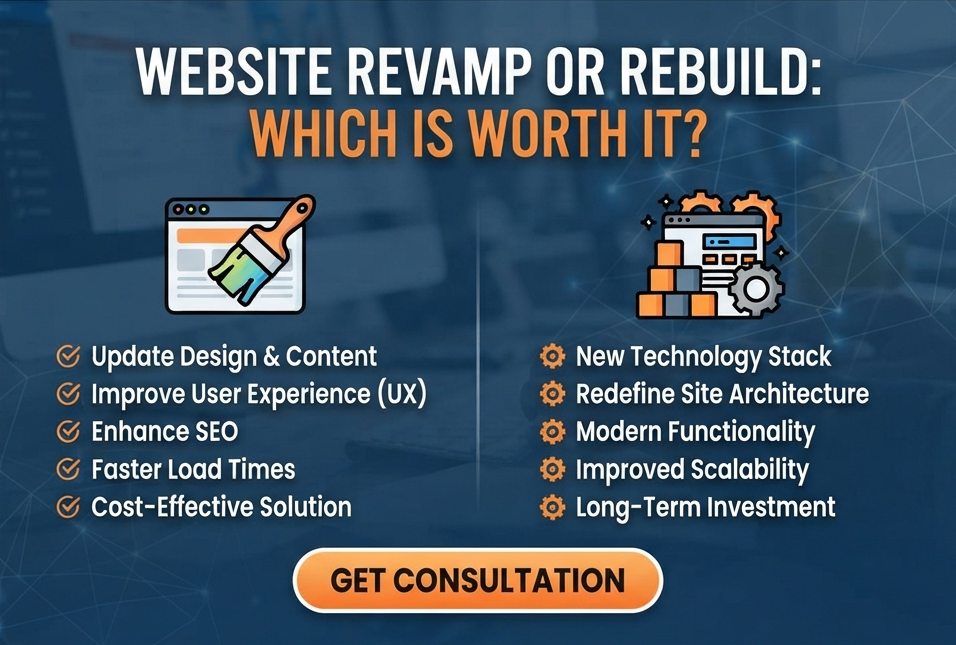
An update maintains the core elements of your site (the system, code and data) and then optimises the visual aspects such as layout, photographs, text and functionality. In contrast, redevelopment alters these core areas and often introduces a new system, system architecture and design. Whereas updating is akin to redecorating, redevelopment is equivalent to returning to the brickwork.
Defining update and redevelopment
As mentioned above, an update is about refreshing. And redevelopment involves replacing.
Typical aspects updated
New designs can be introduced. Product photographs can be improved and menus simplified. Photos can be optimised for swifter loading. Content can also be updated. Generally speaking, an update is a swifter and more economical option. Furthermore, staff will continue to use the familiar system.
Typical aspects redeveloped
This stage involves altering the core components. For example, an expanding retailer may transition to a new system and develop a Magento web design company to support their vastly expanded range. Likewise, a brochure-style site could be given a bespoke web design which is designed with reference to how consumers search. All content and functionality are then adapted to suit the new core components.
How to establish whether an update is suitable
If your site is functionally robust but has become less visually appealing then an update is likely to be appropriate. Provided that your pages load adequately, your system continues to receive updates and staff can edit content without involving developers, and conversion rates are healthy then typically an update provides optimal value with minimal disturbance.
Indicators that an update is suitable
Consumers enjoy your product range but consider your website to be dated. Although photographs were taken in 2016, the checkout and stock management both function well. And predominantly, sites are slow to load due to large image files not poor coding.
As a swift means of analysing this, endeavour to purchase on your mobile phone on a poor network connection. Usually the area where you face difficulty will highlight key issues more effectively than an analysis report.
Even if this resonates with your experience, don’t automatically opt for a redevelopment. Frequently, a thorough update is sufficient.
Indicators that an update is not suitable
You continually resort to hacks. For instance, there may be a booking, and quotation, plugin in operation and a spreadsheet used to link these. Rather than being redecorating, you are now merely supporting the structure.
When genuine functionality is required, for example in relation to customer accounts, quotation and stock, bespoke web application development is necessary. Painting over an existing site will not assist in such instances.
Alongside providing screen shots when instructing a web designer, be sure to also illustrate the hacks currently in force. This conveys significantly greater information than a mood board can.
When is redevelopment more suitable?
If the root of the issue lies beneath the surface – for example, where the system is obsolete, the code is difficult to handle, the system architecture is not conducive to your business, or functionality cannot easily be introduced without causing further complications – then redevelopment is suitable. If continual hacking is all that is proving possible then in effect you are paying for temporary solutions which will, in time, inevitably be superseded. Much as with a leaking roof, you could either persistently place buckets under it or properly repair the roof.
In relation to systems
Initially, some retailers find that their system becomes strained as their range expands. For example, a business may progress from stocking ten products to two thousand, each of which can differ in size, style and combination. Often at this stage, Magento web design is suggested as an option since the system is specifically developed to support extensive ranges and intricate product variations.
Nevertheless, Magento incurs greater hosting, maintenance and financial expenditure in comparison to a standard template-based system. And if you only stock twenty products then you should certainly not consider utilising it.
Regarding design
Whilst templates can satisfactorily serve your business initially, at some stage your enterprise is unlikely to continue to align with them. For instance, a jeweller offering unique items will require markedly differing product pages to a seller of phone cases. Rather than forcing your business into a pre-existing design format, bespoke web design is devised with regard to consumer searching behaviour.
Although initial expenditure and development times are greater, the benefit is that you are not constantly battling with the design as you introduce new elements.
Concerning functionality
At times, websites are in fact more akin to software. Those which allow users to log in, book appointments, obtain quotes and/or monitor orders lie somewhere between a brochure and software. Correct functionality is introduced via bespoke software development rather than by piecing together plugins.
FAQs
How long can a website function effectively before requiring redevelopment?
Whilst there is no definitive timescale, typically sites begin to look dated after between three and five years. Again, this is more of a general indicator. Indeed, analysis of site performance is typically a far more significant factor in determining when redevelopment is required. Poor loading speeds, difficult content editing, poor mobile device compatibility and increasing hack reliance are all highly relevant in this respect.
Can I update my website and then redevelop it at a later stage?
Yes. Numerous businesses adopt this approach. But be sure not to invest in elements which will subsequently be discarded. Typically, update content, imagery and brand design – all of which can be transferred – and refrain from touching elements which are linked to your previous system.
Is bespoke web development essential for an online store?
Usually not. For the most part, established systems efficiently support retailers. Bespoke development comes into its own where existing systems are incapable of adequately dealing with particular processes. These may include, for example, bespoke pricing, a trade customers’ section and/or intricate booking criteria. Should you struggle to articulate precisely where systems fall short then it is likely that you do not actually require bespoke custom web application development.
What questions should I ask a web designer before approving an update or redevelopment?
Find out their assessment of your website’s issues. Ascertain which elements they would retain and establish how old page links will be dealt with. Also, ask who will be responsible for ongoing site management. Should a web designer suggest that you redevelop your site without first analysing your customer insights and site performance then they are speculating and failing to provide knowledgeable guidance.
To summarise
Updating optimises the visual and sensory attributes of your site. In contrast, redevelopment optimises functionality. If your site is functionally robust but aesthetically ageing then typically an update is suitable. However, if your system is antiquated, you frequently hack or lack functionality then redevelopment is likely to be more appropriate. When analysing quotations, bear in mind the annual cost effectiveness of the solution. In your costing analysis, remember to incorporate both content and code expenses. No matter which option you pursue, a good quality web designer will base their suggestion on your analysed issues and will not simply present you with a generic solution. Targeted problem solving is key. And thereafter, leave everything undisturbed.